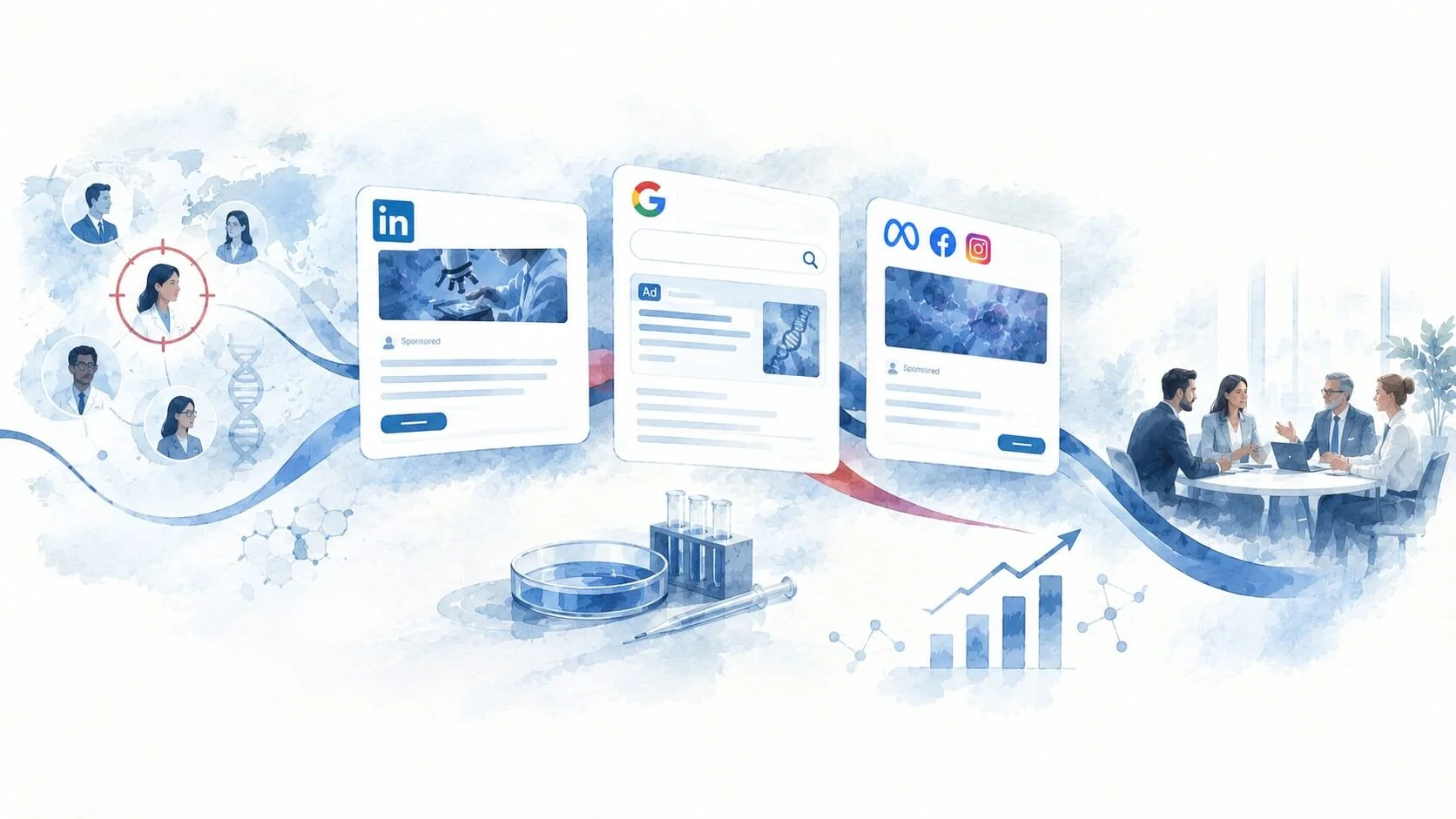
Biotech startup marketing strategy: A guide for founders
Building a biotech startup is hard enough without also having to become a marketer. Your time is pulled in every direction: R&D, regulatory strategy, team building, and fundraising. Marketing rarely makes it to the top of the list.
That instinct is understandable. It also consistently costs companies time, relationships, and credibility that take years to rebuild.
The biotech companies that gain an early commercial advantage are rarely those with the biggest budgets. They are the ones that start building visibility, credibility, and relationships before they need them and who make deliberate decisions about where to focus their limited marketing time and money at each stage of growth.
This blog walks you through a stage-by-stage marketing strategy for biotech startups, what to prioritise from pre-seed through to Series A and beyond, which channels actually work in this sector, and when bringing in external support makes more sense than building in-house.
Table of contents
- Why marketing matters before you're ready to sell
- The foundation: define your audience before you build anything
- Stage-by-stage marketing priorities
- Series A: building a systematic marketing infrastructure
- Series B and beyond: scaling what works
- The channels that work in biotech: a prioritised view
- The most common marketing mistakes biotech startups make
- Conclusion
Why marketing matters before you're ready to sell
The most common objection from biotech founders to early-stage marketing investment is some version of: “We don’t have anything to sell yet.” It is a logical position. It is also wrong in practice.
For a biotech startup, marketing performs three functions long before a product reaches market:
- Credibility with investors. Investors don’t only evaluate your science, they evaluate whether you can build a company around it. A startup with a coherent online presence, a founder who is visible and credible in the sector, and content that demonstrates scientific and strategic depth signals execution capability. A startup that is invisible until its pitch deck arrives signals the opposite.
- Partnership and collaboration pipeline. In biotech, the most valuable early relationships, academic collaborations, CRO partnerships, distribution agreements, and licensing discussions begin with a form of marketing. A potential partner discovering your work through a conference presentation, a LinkedIn post, or a search result is not an accident. It is the result of deliberate visibility.
- Talent attraction. The scientists, regulatory experts, and business development professionals you need are scarce and selective. A company that communicates clearly about its mission, its science, and its culture attracts better candidates than one that doesn’t. Your website and LinkedIn presence are your first interview with every future hire.
The foundation: define your audience before you build anything
The single most common marketing mistake at early-stage biotech companies is building a brand, a website, or a content strategy before defining precisely who the audience is.
A practical approach is to conduct at least 10 – 15 interviews with customers or stakeholders before committing to any significant marketing asset.1 These interviews surface the language your audience actually uses, the problems they prioritise, the objections they raise, and the channels where they spend time. Every marketing decision made after those interviews will be more accurate and more cost-effective than one made without them.
Define your audience in terms of:
- Role and seniority: who specifically makes or influences the buying, partnering, or investment decision?
- Organisation type: academic institution, pharma, CRO, hospital, VC firm, regulatory body?
- Primary pain or objective: what are they trying to solve or achieve that your technology or company addresses?
- Information behaviour: where do they go when they want to learn something? (LinkedIn, PubMed, conference proceedings, industry newsletters, peer referral?)
Stage-by-stage marketing priorities
Marketing strategy should match your company’s stage of development. What makes sense at pre-seed is often counterproductive at Series A, and vice versa.
Pre-seed and seed stage: visibility and credibility
At this stage, you have limited resources, limited proof points, and maximum need to build recognition with a small, targeted audience of investors, potential partners, and scientific collaborators.
A founder’s personal brand is your primary marketing asset. Before your company has built a reputation, you have. Your professional network, your publication record, your conference presence, and your LinkedIn activity are the fastest and most capital-efficient ways to build early visibility. Focus 80-90% of your social media effort on personal profiles from founders and key scientific leads rather than on the company page.
What to build at this stage:
- A professional website with clear positioning: who you are, what technology you’re building, and why it matters. This does not need to be elaborate, but it must exist and be findable. A website that doesn’t rank for your company name is a problem.
- A LinkedIn company page that mirrors the positioning of your website and is actively maintained with content at least once per week.
- A clear scientific narrative, a two-paragraph explanation of your technology that a non-scientist investor can understand and that a specialist scientist finds technically credible. This is harder to write than it sounds and is worth a significant time investment.
- An email list, even a small one. A database of 200 genuinely interested contacts in your sector is worth more than 2,000 LinkedIn followers with no context.
What to defer at this stage:
- Paid advertising. Without a defined commercial offer and a conversion point, paid campaigns burn budget without producing results.
- Elaborate brand identity work. A professional but simple visual identity is sufficient. You can invest in full brand development at Series A.
- Publishing cadences that you cannot sustain. One high-quality piece of content per month, consistently, outperforms four pieces published in one burst and then nothing.
Non-dilutive funding as a credibility signal. According to the Biotechnology Innovation Organization (BIO) 2024 Start-Up Survey, 38% of seed-stage biotech companies identified non-dilutive funding (grants, Horizon Europe awards, SBIR/STTR) as a primary strategy for the coming year.2 EU Horizon Europe and US SBIR/STTR programmes collectively tracked approximately $5.2 billion in biopharma funding awards in 2024.3 Grant awards are also a marketing asset: they signal external validation of your science to investors and partners, and they are worth communicating actively through your channels.
Series A: building a systematic marketing infrastructure
At Series A, you have proof of concept, a team that is growing, and commercial conversations beginning in earnest. Marketing at this stage shifts from founder-led visibility to systematic, channel-based lead generation.
Priorities at Series A:
A content marketing strategy grounded in SEO. By Series A, you should understand what your potential customers, partners, and investors are searching for online. A structured SEO and content programme, targeting the specific questions your audience asks in search, builds long-term organic visibility that compounds over time. A single well-ranked article on a high-intent keyword can generate qualified inbound contacts for years.
A clearly structured website with conversion points. Your website should now do more than present your science. It should guide different audience segments, investors, potential partners, and potential customers to appropriate content and to a specific action: contact, download, or demo. A website without clear conversion paths is a brochure.
LinkedIn as a primary B2B channel. For most life science B2B companies, LinkedIn is where professional audiences spend time and make decisions. A systematic approach, thought leadership from founders and team members, consistent company page activity, and targeted paid campaigns for specific objectives should be running by Series A. See our full LinkedIn marketing guide for life science companies for specific tactics and benchmarks.
A defined marketing budget. “We’ll spend what we have to” is not a marketing budget, it produces inconsistent, unmeasurable results. A structured allocation tied to specific objectives, with KPIs to evaluate performance, is necessary at Series A. For guidance on how to set and allocate a marketing budget appropriate to your stage, see our life science marketing budget guide.
When to hire external support. The question most founders ask at Series A is whether to hire in-house or work with an agency. The honest answer depends on your timeline and the skills gap. In-house marketing builds institutional knowledge but takes 6–12 months to become fully productive. A specialist life science marketing agency can execute faster and brings sector-specific knowledge, but requires clear briefing and close collaboration to be effective. Many Series A companies run a hybrid: one in-house marketing manager handling day-to-day and an external agency handling specialist work (SEO, paid media, content production).
Series B and beyond: scaling what works
At Series B, the marketing challenge shifts again. You are no longer building from scratch, you are identifying what is working and allocating more resources to it, while entering new markets or audience segments that require new approaches.
Consistency and systematic execution become more important than experimentation.
Priorities at Series B:
- Invest in attribution. Know which channels are generating qualified leads and pipeline, not just website traffic.
- Build a demand generation function that operates independently of the founding team’s personal networks.
- Develop account-based marketing (ABM) approaches for high-value target accounts, particularly if your commercial focus is on a defined list of large pharma, CRO, or hospital system prospects.
Consider a conference and events presence scaled to your commercial territory. Events in life sciences are high-cost but high-value relationship channels. Budget for follow-up infrastructure, not just the booth.
The channels that work in biotech: a prioritised view
Rather than listing every possible marketing channel, here is a prioritised view based on what consistently produces results for early-stage life science companies:
Priority 1: LinkedIn (organic and paid). The primary B2B professional platform in life sciences. Organic content from founders and key scientists builds long-term credibility. Paid LinkedIn campaigns allow you to reach specific job titles and organisations with precision. See our LinkedIn marketing guide for specifics.
Priority 2: Content marketing and SEO create compounding organic visibility over 6–18 months. Best suited for companies with an educational story to tell, which describes most biotech companies. Topics: technology explainers, application notes, sector challenges, regulatory developments, research summaries.
Priority 3: Email and CRM. The highest-converting channel for an engaged list. Build your list early and consistently. Segment by audience type. Even a monthly newsletter to 300 relevant contacts outperforms an uncontacted list of 3,000.
Priority 4: Conferences and events. High cost and difficult to attribute directly, but essential for relationship-building in a sector that still runs on trust and personal connection. Budget for the follow-up (post-event content, CRM sequences, email outreach) as well as the event itself.
Priority 5: PR and media. Trade publications reach the specific audiences most relevant to life science companies. A well-placed article or interview generates inbound enquiry and third-party credibility that paid advertising cannot replicate. Non-dilutive funding awards, partnership announcements, and clinical milestones are all press-worthy at an early stage.
The most common marketing mistakes biotech startups make
Waiting until you have a product to start marketing. Credibility, relationships, and search visibility all take time to build. Starting at product launch is starting 18 months late.
Trying to speak to everyone at once. Investors, scientists, clinicians, procurement managers, and regulatory professionals have entirely different information needs. A message calibrated for all of them will land for none of them. Start with your single most important audience and build from there.
Building a beautiful website with no SEO foundation. A visually impressive website that doesn’t rank for any relevant search terms is invisible to anyone who doesn’t already know your name. Design and discoverability must be built together.
Measuring the wrong things. Followers, impressions, and website sessions are easy to track, but don’t tell you whether marketing is working. The metrics that matter are qualified leads generated, cost per lead, and pipeline attributed to marketing activity.
Publishing inconsistently. One article per month, every month, for a year, produces better SEO results than ten articles published in a burst and then nothing for six months. Consistency signals to Google that the site is actively maintained. It also builds audience trust.
Conclusion
There is no universal biotech startup marketing playbook, the right approach depends on your stage, your audience, and your commercial model. But the companies that consistently outperform their peers in visibility, partner acquisition, and investor interest share a common pattern: they start earlier, they define their audience more precisely, and they show up more consistently than the competition.
Marketing in biotech is not about spending more. It is about making deliberate decisions at each stage, measuring what works, and building the foundations of visibility and credibility before you need them.
If you want to talk through your specific situation, what to prioritise, what to defer, and what kind of support makes sense at your current stage, get in touch. We work exclusively with life science companies and can help you build a marketing approach that matches where you are and where you’re going.
Questions or need guidance? Send us a message, we’re happy to help!
Any questions about biotech marketing?
Let's talk!
Frequently asked questions about biotech startup marketing strategy
When should a biotech startup start thinking about marketing?
Earlier than most founders expect. Before Series A, ideally from founding, you should have a professional website, an active LinkedIn presence from key team members, and a clear scientific narrative. Waiting until you have a commercial product means starting from zero visibility at the moment visibility matters most.
How much should a biotech startup spend on marketing?
Early-stage biotech companies without established revenue commonly invest a higher proportion of their funding in marketing than mature companies, since building initial visibility requires upfront investment. For a detailed framework with models and benchmarks, see our life science marketing budget guide.
What is the single most important marketing priority for a pre-seed biotech?
A clear, credible scientific narrative communicated consistently, primarily through LinkedIn from the founder’s personal profile. Before you invest in any paid channel or elaborate content programme, make sure the story you’re telling about your technology is one that both specialist and non-specialist audiences can understand and find compelling.
Should a biotech startup hire in-house marketing or work with an agency?
At pre-seed and early seed, founder-led marketing (personal LinkedIn, basic website) is both sufficient and most authentic. By Series A, most companies benefit from a combination: an in-house generalist who owns execution and a specialist external partner who handles the areas requiring deeper expertise (SEO, paid media, design).
Do biotech startups need to be active on social media beyond LinkedIn?
For most B2B biotech companies, LinkedIn should be the primary and first social channel to build. Twitter/X has a relatively active biotech and life sciences community, but it is secondary. Instagram and Facebook are relevant only for companies with a B2C component or a significant employer brand focus. Spreading effort across multiple channels before building a meaningful presence on one is a common early-stage mistake.
How long does it take for content marketing and SEO to produce results for a biotech startup?
Typically 6–12 months before you see meaningful organic traffic from search engines. This is why starting early matters. A company that begins an SEO programme at seed stage has built real search visibility by Series A. One that starts at Series A is building visibility during a period when commercial traction is already expected.
References
- https://www.bioprocessintl.com/economics/navigating-choppy-waters-three-resilient-marketing-tactics-for-biotechnology-companies-amid-market-turmoil
- https://confidenceresearch.com/scarcity-breeds-strategy-how-biotech-companies-are-navigating-the-2024-2025-funding-crunch-2/
- https://qubit.capital/blog/mastering-biotech-startup-funding-strategies