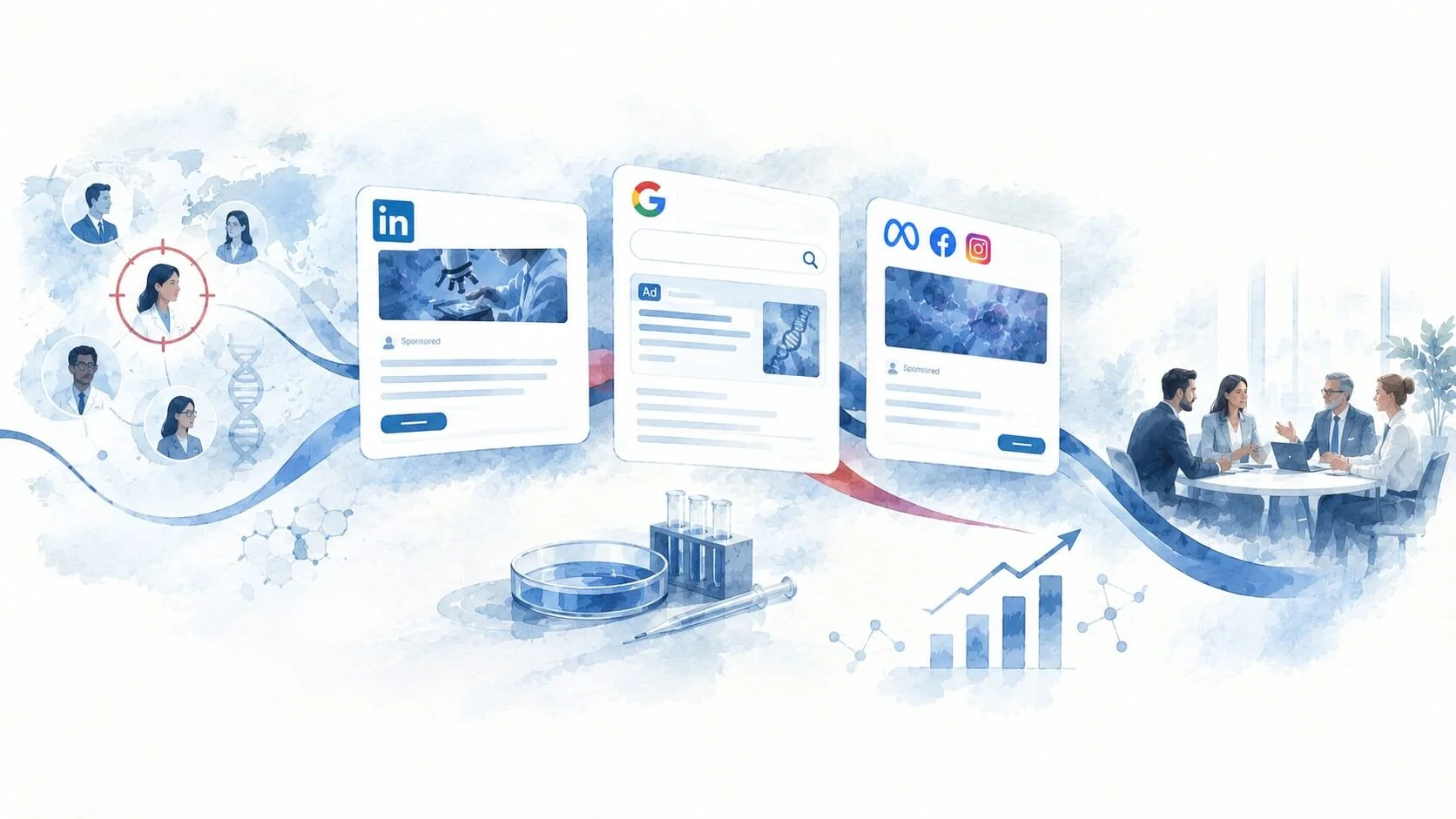
How to position your life science company for partnerships
More than 1,200 biotech partnership deals were announced globally in 2025, with a combined disclosed value exceeding $250 billion. The pipeline for collaboration between early-stage life science companies and larger pharma, medtech, and CRO partners has never been more active.
Yet for most founders and business development professionals at small and mid-sized life science companies, the challenge is not finding partnership opportunities. It is getting into the room in the first place.
The companies that consistently attract partnership conversations share a common characteristic: they have invested in how they present themselves before they ever sit down with a potential partner. Their narrative is clear, their online presence reflects where the company actually is, and the people they want to reach have encountered them before the first formal introduction.
Table of contents
- Why positioning determines who gets into the room
- What pharma and medtech BD teams actually evaluate
- Building the narrative that attracts the right partners
- Digital presence as a partnership credibility signal
- How to become visible to potential partners before you reach out
- Making the most of partnering meetings when you get them
- Conclusion
Why positioning determines who gets into the room
Pharma and large medtech companies are increasingly dependent on external innovation to fill their pipelines, which means their BD teams are actively scanning for partnership opportunities at smaller companies.
But BD teams at large organisations do not evaluate every company that approaches them. They work from shortlists built on prior knowledge: companies they have seen present at conferences, whose publications they have read, whose leadership they follow on LinkedIn, or whose websites they have visited while researching a therapeutic area.
Positioning is not about making your science sound better than it is. It is about making sure that the quality of your science and the strength of your team are clearly communicated to the right people, in the places they look, before you need anything from them.
What pharma and medtech BD teams actually evaluate
Large pharma BD teams evaluate potential partners on several dimensions beyond the science itself.
- Scientific credibility and data quality. The science is the baseline. BD teams assess the strength of your data, your IP position, and the clarity of your regulatory pathway. But this evaluation often starts online, through publications and website content, before any direct conversation.
- Management quality and execution track record. For early-stage companies, a partnership with a credible pharma company validates both the science and the management team. BD teams are evaluating whether you can execute and whether your leadership communicates with clarity and confidence.
- Strategic fit and complementarity. Potential partners are looking for assets and capabilities that complement their existing portfolio or address specific gaps. The more clearly you articulate where your technology fits, the more efficiently you move through the evaluation process.
- Partnership readiness. BD alliances may fail not due to the science, but due to integration friction. Experienced BD teams evaluate whether a potential partner has the operational maturity and governance capability to sustain a long-term collaboration.
Building the narrative that attracts the right partners
- Define your partnership thesis explicitly. Before approaching any potential partner, articulate clearly: what kind of partnership are you seeking, with whom, and for what purpose? A vague ‘we are open to partnerships’ position is far less compelling than a specific, well-defined partnership thesis.
- Position your technology in the landscape, not in isolation. Your narrative needs to map your technology onto the competitive landscape and explain clearly what gap it fills. You need to think about the landscape, what is the bridge, what is the gap you are filling.
- Be explicit about what you bring and what you need. Clarity on what you offer, what you lack, and what you want from a partner accelerates conversations and builds trust faster than strategic ambiguity.
- Keep the narrative consistent across all channels. Your pitch deck, website, LinkedIn presence, conference presentations, and executive interviews should all tell the same story. Inconsistency creates doubt at exactly the wrong moment.
Digital presence as a partnership credibility signal
BD professionals and their teams research potential partners online before any direct engagement. Your website and LinkedIn presence are not peripheral to the partnership development process, they are part of the due diligence.
Your website
A website that clearly articulates your technology, your team, your data, and your regulatory status tells a BD team in five minutes what a first meeting might take an hour to establish. Showcasing existing partnerships through your website is particularly effective. A company that has successfully managed one partnership is a lower-risk candidate for the next one.
The personal LinkedIn profiles of the founding team and key BD professionals are among the first things that large company BD teams check. An active, consistent presence from the company’s leadership signals domain expertise and sector engagement. A founder who has never posted on LinkedIn is harder to evaluate than one who has been consistently active for the past year.
How to become visible to potential partners before you reach out
- Publish in the places your partners read. Scientific publications, white papers on platform capabilities, and application notes that demonstrate your technology’s breadth all build awareness with the BD teams at potential partners.
- Be present at the conferences where partnerships form. Consistent presence builds the prior awareness that makes direct outreach warmer.
- Use partnering platforms proactively. Most major life science conferences operate partnering platforms for one-on-one meetings with BD teams at large pharma and medtech companies. Companies that use them proactively and with specific, well-prepared meeting requests generate more qualified conversations.
- Develop your existing network systematically. In life sciences, partnerships are largely relationship-driven. The most efficient path to a new partnership conversation is through someone who already has a relationship with the BD team you want to reach.
Making the most of partnering meetings when you get them
- Know their portfolio and strategy before you walk in. BD teams are immediately more engaged with companies that demonstrate they understand the potential partner’s existing portfolio, therapeutic focus, and recent deal activity.
- Lead with strategic fit, not just science. The meeting is not a scientific presentation. It is a conversation about whether there is a basis for collaboration. Lead with why your technology is relevant to their specific situation, then provide the scientific detail that supports it.
- Be clear about what you are seeking. Whether it is a co-development agreement, a licensing discussion, or a distribution arrangement, stating your objective clearly at the outset helps the BD team evaluate whether there is a basis to continue.
- Follow up with structured next steps. Before leaving, agree on what each party will do next and by when. Then follow through within 48 hours.
Conclusion
Partnerships in life sciences are relationship-driven and increasingly competitive. The companies that consistently attract the right conversations are not necessarily those with the best science, they are the ones who have invested in making that science visible, credible, and strategically framed to the right audiences.
Building that positioning is not a one-off project. It is a sustained programme of narrative development, digital visibility, conference presence, and relationship management that runs alongside your scientific and commercial development.
Questions or need guidance? Send us a message, we’re happy to help!
Any questions about life sciences marketing?
Let's talk!
Frequently asked questions about partnership positioning
What do pharma BD teams look for in a potential partner?
Beyond the science itself: management quality and execution track record, the strength and clarity of your IP position, your regulatory pathway, and your partnership readiness. Some of BD alliances fail due to integration friction rather than scientific issues, so operational credibility matters as much as scientific credibility.
How early should a life science company start building its partnership positioning?
Earlier than most founders expect. The prior awareness that makes direct outreach effective takes time to build through publications, conference presence, and consistent digital visibility. Starting 12 to 18 months before you want to have serious partnership conversations gives you time to build the narrative and visibility that supports it.
How important is LinkedIn for partnership development in life sciences?
More important than most founders realise. BD teams at large organisations research potential partners online before any direct engagement, and the personal LinkedIn profiles of founding team members are among the first things they check. A consistent, active presence from your leadership builds a body of evidence about your team’s expertise that supports the partnership narrative.
What is the biggest mistake companies make when pursuing partnerships?
Approaching potential partners before the positioning is in place. A cold approach from a company with an unclear narrative, an outdated website, and no visible conference presence is significantly harder to advance than a warm conversation with a company whose story the BD team already knows.
How does digital content support partnership development?
Content published on your website and shared through LinkedIn builds awareness with the scientific and BD teams at potential partners before any direct conversation. White papers, application notes, and thought leadership pieces function as pre-meeting credibility signals. Showcasing existing collaborations through your website also signals partnership experience and reduces perceived risk for potential new partners.
When does it make sense to work with a specialist agency on partnership positioning?
When you need to build a cleaner narrative, a stronger digital presence, or more consistent content output than your internal team can manage alongside everything else. A specialist life science marketing agency with experience in BD-stage companies can help you build the positioning infrastructure that makes your outreach more effective.
References
- https://6sense.com/blog/dont-call-us-well-call-you-what-research-says-about-when-b2b-buyers-reach-out-to-sellers/